
The mill yard in December is not a welcoming place. The wind comes across the scrap piles and finds every gap in your jacket. The gatehouse is warm, but the rest of the plant is a series of large, cold buildings connected by walkways that seem longer than they did in June. I was there to see the stainless steel plate line, partly because we had been quoting more plate than usual and partly because a mill visit in winter tells you things a mill visit in summer does not.
The first photo is the slab yard, just after sunrise. The slabs are stacked in rows, 304 and 316L mostly, with a few 2205 duplex slabs at the far end under a separate cover. The slabs are grey and rough, the surface still carrying the marks of the continuous caster. In December, the slab yard is where you notice the humidity. The slabs are cold, and the air is damp, and condensation forms on the surface as the day warms up. That condensation is the reason the slabs do not sit in the yard for long if the mill can help it. A slab that is wet on the surface goes into the reheating furnace with moisture on it, and moisture in a furnace is never a good thing. The mill schedules the slab yard tightly in winter for that reason.
The second photo is the furnace door, with a slab moving in on the roller table. You can see the orange glow spilling out onto the floor and the operator in the control pulpit, watching the temperature curve on a screen. The furnace is the start of the plate line, and it is also the bottleneck. A slab that is not heated evenly will not roll evenly, and a plate that is not rolled evenly will have thickness variation that no amount of downstream processing can fix. The operator told me that December is a tricky month because the incoming slab temperature is lower, so the furnace has to work harder to bring the slab to rolling temperature, and the energy cost goes up. That is not a quality issue, but it is a cost issue, and it explains why some mills are reluctant to take small orders in the winter.
The third photo is the rolling stand, with the plate emerging from the gap. The plate is long and flat and still glowing, and the scale is breaking off the surface in flakes. The roller table is moving it toward the next stand, and the water sprays are cooling the rolls. The noise is not as loud as you might expect—it is a deep, rhythmic sound, like a heavy door closing in another room. The operator in the pulpit is watching the thickness gauge, and the gauge is printing a chart that shows the thickness profile across the length of the plate. That chart is the first real quality record of the plate, and it travels with the plate through the rest of the line.
The fourth photo is the annealing furnace, where the plate is heated to soften it and relieve the stresses from rolling. The plate is stacked on a tray and moved into the furnace on a roller hearth. The annealing temperature and the cooling rate determine the final mechanical properties, and the mill keeps a record of both. I asked the metallurgist what he watches most closely in December, and he said the cooling rate. The ambient temperature in the plant is lower, and the cooling air is colder, so the plate cools faster than it does in summer. That is not necessarily a problem, but it has to be accounted for in the schedule. A plate that cools too fast can have residual stresses that show up later as distortion during machining. The mill adjusts the cooling cycle for the season, and the record shows it.
The fifth photo is the pickling line, where the plate goes through a series of acid baths to remove the oxide scale from the surface. The line is enclosed, and the only visible part is the entry and exit, where the plate goes in dark and comes out silver. The pickling line is the part of the process that most people do not think about, but it is the reason a stainless plate looks like stainless. The acid concentration and the line speed are controlled, and the plate is rinsed and dried before it moves to inspection. The operator at the exit is checking the surface for residual scale and for any pickling defects—stains, streaks, or areas where the acid did not fully remove the oxide. That check is visual, and it is done under a bright light that shows every imperfection. A plate that fails that check goes back for re-pickling or is downgraded.
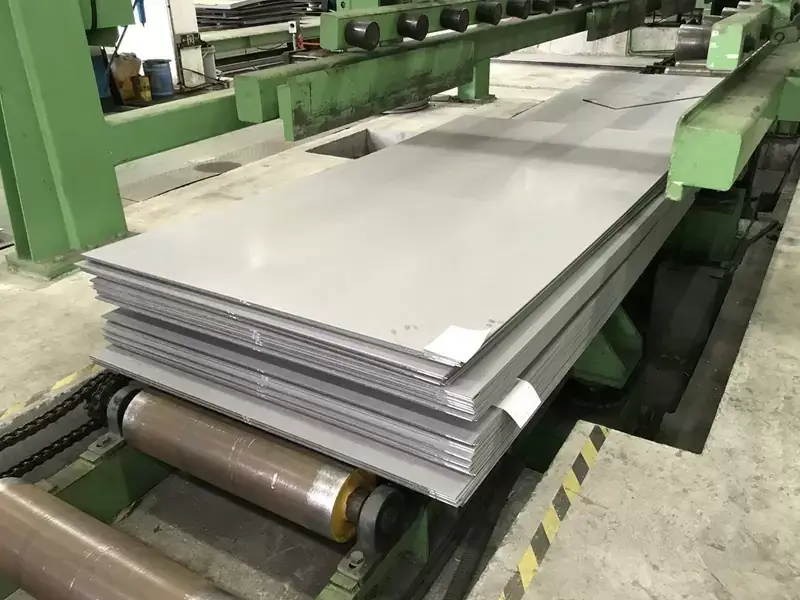
The sixth photo is the inspection table, where the plate is laid flat and checked for flatness, thickness and surface condition. The inspector is using a straight edge and a feeler gauge, and he is marking the plate with a soapstone where the deviation exceeds the standard. The plate is 6 mm thick and 2,000 mm wide, and the flatness check takes several minutes because the plate has to be measured at multiple points. The inspector told me that December is a busy month for him because the mill is trying to clear orders before the year-end shutdown. The plates are moving through faster, and the inspection is the last gate before packing. A plate that is out of tolerance here is a plate that does not ship, and the mill would rather catch it now than have it come back.
The last photo is the packing area, where the plates are stacked, interleaved, banded and tagged. The plates are wrapped in VCI film and the edges are protected with plastic corner pieces. The tags show the heat number, the grade, the size and the customer reference. The packing crew is working in a cold part of the building, and they are wearing gloves that still allow them to handle the tags and the strapping. The plates are stacked on wooden skids and banded with steel straps, and the skids are loaded onto trucks that are waiting in the yard. The mill ships in December, but the schedule is tighter than usual, and a plate that misses the truck may sit until January.
The visit ended in the gatehouse, with a cup of coffee and a look at the production schedule for the next two weeks. The mill was running at a steady pace, not flat out, but not slow either. The December schedule was full of orders that had been placed in October and November, and the sales manager said that the January schedule was already filling up. That is the thing about a mill visit in December. You see the end of one year's work and the beginning of the next, and you understand that the plate you order in the spring starts with a slab that was scheduled in the winter. The line is running. The photos are a record of what that looks like when the weather is cold and the year is closing.
Feel free to contact us


You can consult us at any time if you have any questions. You can email or call us at any time, and we will reply to you as soon as we receive your information.